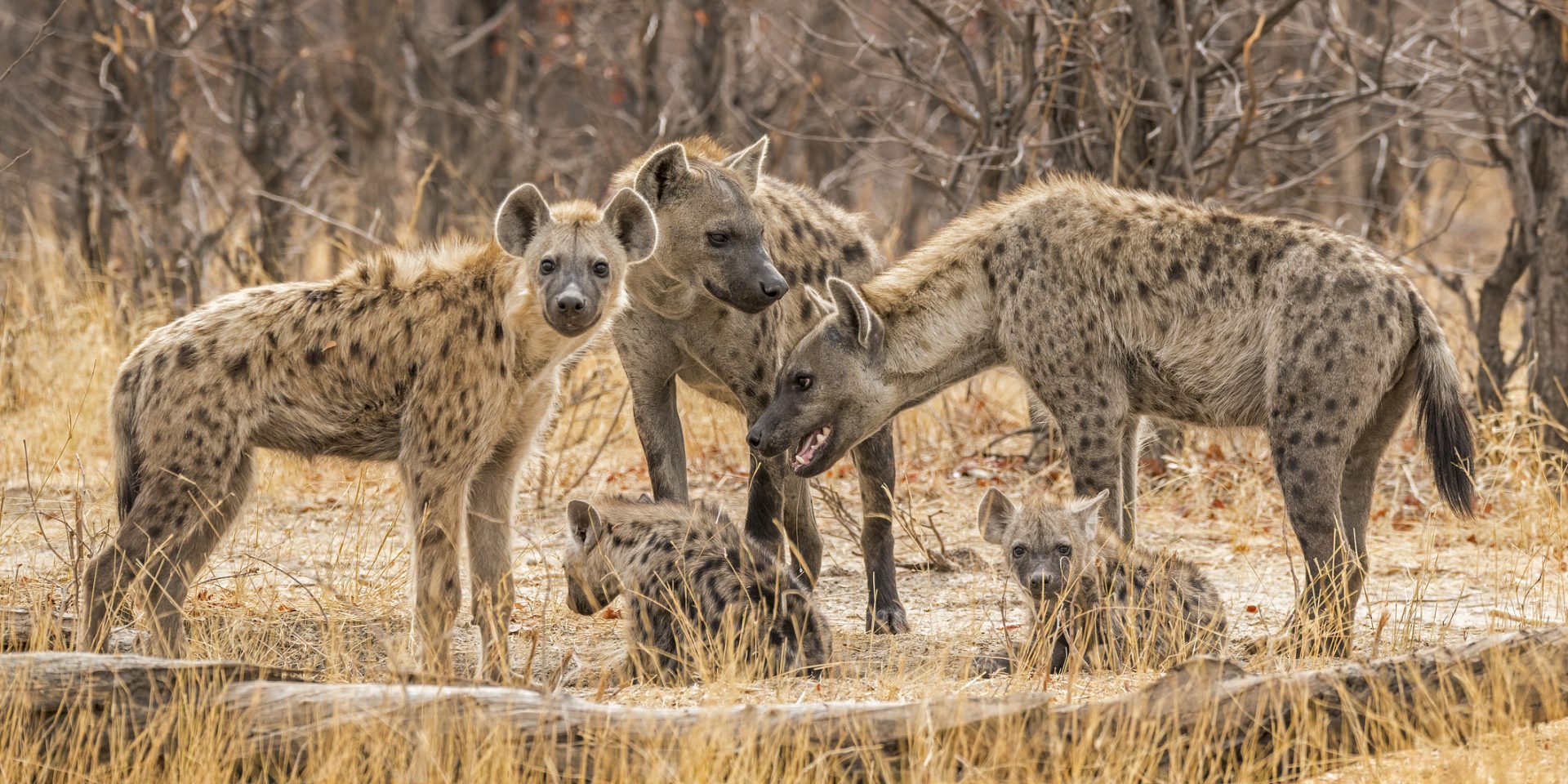
This International Hyena Day, conservationists are calling on the public to take a fresh look at the hyena – an animal often cast as the villain of the African savanna. With their haunting howls and unconventional appearance, hyenas have long been mischaracterised as destructive and cowardly scavengers or pests. But the truth is far more intriguing.
While most people are familiar with the spotted hyena, the Hyaenidae family actually consists of four species, including the striped hyena, brown hyena, and aardwolf—and they are all unique.
 Top left: Spotted hyena; Top right: Striped hyena; Bottom left: Brown hyena; Bottom right: Aardwolf
1. The spotted hyena, often nicknamed as the “laughing hyena”, is the most widespread and well-studied of the four species, found throughout sub-Saharan Africa. Mischaracterised as mere scavengers, they are in fact among Africa’s most skilled predators—hunting up to 90% of their food using strategy, team work and remarkable endurance. Spotted hyenas live in large, complex social clans, which can number up to 80 individuals. These clans are female-dominated as they are larger, stronger, and live longer than males. They have an incredibly rich vocal repertoire, including their renowned laugh, used to communicate group movements, assert rank, and strengthen social bonds. Studies show they’re capable of problem-solving, planning ahead, and learning from past experiences. Despite being classified as Least Concern by the IUCN, their populations are declining, with fewer than 50,000 estimated left across the African continent.
2. With their grey coats and dark vertical stripes, striped hyenas are classified as Nearly Threatened with less than 10,000 mature individuals left in the wild. They are found in North and East Africa, but are already extinct in many other areas of Africa and their populations continue to decline. Research shows that unlike spotted hyenas, they are primarily nocturnal and tend to be solitary or found in very small groups. Striped hyenas are opportunistic omnivores, feeding on a mix of small animals, fruits and vegetables. They are also the biggest carcass-scavengers of the family. Interestingly, research suggests they use “natural lavatories” to communicate via scent—sharing information about their territory, reproductive status, and group presence.
3. Found mainly in southern Africa’s arid deserts and savannas, the brown hyena is recognised by a long, shaggy dark brown coat and cream-coloured mane. Although their population is stable, they are still classified as Near Threatened by the IUCN, with just over 10,000 left in Africa. They are predominantly scavengers, but also supplement their diet with fruits and vegetables, insects, birds’ eggs, and occasionally small animal prey. Brown hyenas live in small clans, typically consisting of related females and their cubs, while males may remain in their natal clan, become nomadic, or join new groups. One fascinating adaptation is their incredibly powerful sense of smell, used to locate carcasses over long distances.
4. The aardwolf is the smallest and most specialised member of the hyena family. Despite their name, aardwolves are not related to wolves—they simply share the name due to similar size and shape. They are classified as Least Concern, indicating they are not threatened, but their exact numbers are unknown due to their shy nature. Unlike its carnivorous relatives, the aardwolf feeds almost exclusively on termites. A single aardwolf can consume up to 300,000 termites in one night using their long, sticky tongue. They are socially monogamous, and typically live alone or in pairs. As they feed mostly on insects, one of the biggest threats to aardwolves is pesticide use, aimed at controlling locusts and termites.
While various hyena species differ in mannerisms and social structures, their ecological roles are equally indispensable. Hunting hyenas help regulate herbivore populations, ensuring a natural balance within the food chain. Scavenging hyenas perform a critical ecosystem service by consuming and cleaning up carcasses that could otherwise contribute to the spread of disease. In doing so, they not only keep habitats clean and healthy but also return vital nutrients to the soil, supporting the delicate web of life that underpins biodiversity. Additionally, by feeding on invertebrates such as beetles and termites, hyenas help control insect populations that could otherwise damage grasslands and diminish plant diversity.
Although hyenas play a crucial role in maintaining healthy ecosystems, they are facing increasing threats, leading to population declines across much of Africa. Most of these challenges stem from human activity:
- Persecution fueled by fear, superstition, and misinformation about the species.
- Loss of habitat due to agricultural expansion and human settlement.
- Human-wildlife conflict with farmers and local communities, particularly when livestock is threatened.
- Hunting for bushmeat and for use in traditional medicines.
- Accidental deaths from poisoning, snaring, and vehicle collisions.
Peter Knights OBE, CEO of Wild Africa, stated, “Despite a negative public image leading to their persecution, hyenas are doting parents and smart and skilful hunters playing a vital role keeping other populations in check and preventing disease by cleaning up carcasses. Changing hearts and minds is the first step to securing their future.”
Hyenas remind us that beauty in nature comes in many forms. This International Hyena Day, let’s dispel the damaging myths about these species and celebrate them for what they truly are—resilient, intelligent, and essential to the health of the ecosystems they help sustain.